

 Data Sheet
 Meinberg Product Page
Last Update: 2025-12-07
© 2003 - 2025,
GPS183PEX: GPS Time Receiver for PCI Express - low profile board
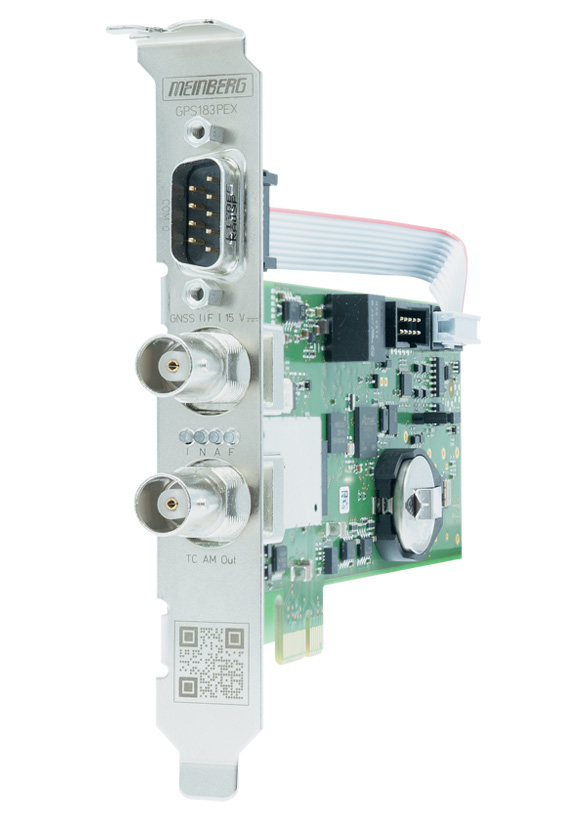
Key Features:
- PCI Express Interface
- 2x time trigger inputs
- Programmable Pulse Outputs
- Frequency Synthesizer and Time Code Mode
- Memory Mapped I/O time reads for high access rates
- RS-232 interface
- IRIG-B/AFNOR time code outputs
- Plug and Play
- DCF77-simulation
- Configurable time scale (UTC/local, GPS time, TAI)
- Driver software for all popular operating systems
- Included GPSANTv2 antenna uses downconverter technology to enable long transmission routes of up to 1100 m (1200 yards) -- with Ultraflex H2010 cable
The GPS183PEX is a 12-channel satellite clock PCI Express card (low-profile) with Meinberg's GPS technology that has been developed from the ground up specifically for time and frequency synchronization purposes. The GPS183PEX is designed to receive signals from the U.S. Global Positioning System (GPS), allowing precise synchronization of your PC’s clock and generation of high-precision, high-accuracy time and frequency signals anywhere in the world.
The GPS183PEX features not only a BNC connector for amplitude-modulated timecode (TC AM) output, four status LEDs, but also a 9-pin D-Sub male connector with outputs for time signals generated by the GPS183PEX, including serial time strings and programmable signals (including pulse-per-second and pulse-per-minute signals).
The GPS183PEX is shipped with a standard slot bracket with recesses the antenna BNC connector, the AM timecode output BNC connector and the four status LEDs. This bracket also features an integrated D-Sub 9 male connector for outputting serial time strings and programmable signals.
The GPS183PEX also includes a 'low-profile' slot bracket which can be used to replace the standard bracket for installation of the GPS183PEX in low-profile chassis form factors such as 1U rack servers. When using the low-profile bracket, the signals that would otherwise be output via the D-Sub connector are instead output via a box header mounted on the board itself.
Legacy interfaces like IRIG, 1PPS or serial time strings can be used to connect other equipment to the PCIe slot card and transfer the time base over dedicated cable connections to systems which cannot be synchronized via NTP or other network protocols.
The driver package for Linux contains a kernel driver which allows the board to be used as a reference time source for the NTP daemon which is shipped with most Linux distributions. This also turns the computer into a NTP time server which can also provide accurate time to other NTP clients on the network. Some command line tools can be used to setup configurable parameters and monitor the status of the board.
